

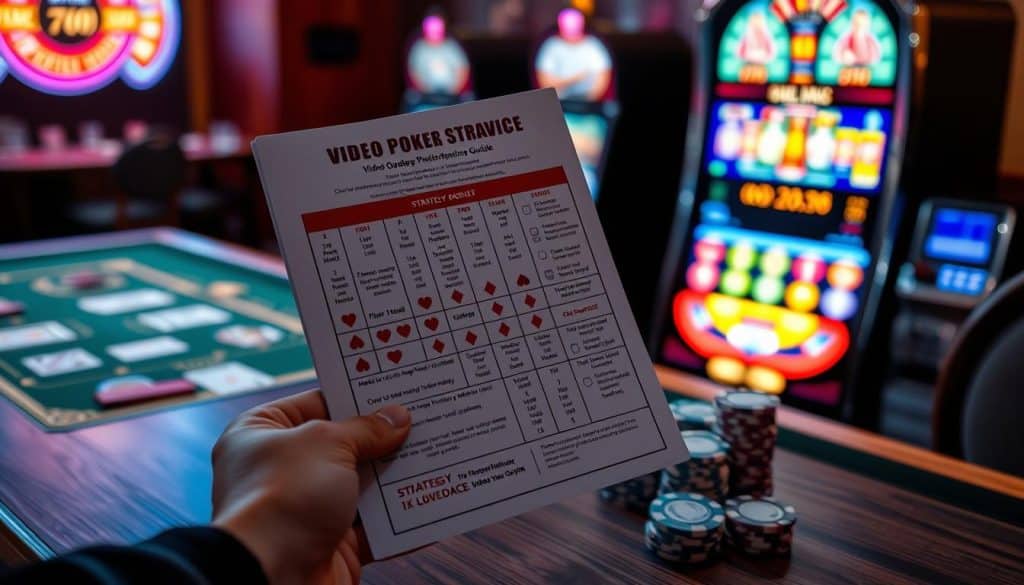

About 60% of casino visitors treat video poker like a slot machine. They sit down, push buttons, and hope for the best. They don’t realize video poker isn’t pure chance.
Your decisions directly impact your results. This game sits between slots and traditional poker. Skill and strategy actually matter here.
I learned this the hard way during my first casino visit. A player next to me made consistent money while I lost mine quickly. The difference wasn’t luck—it was knowledge.
That experience sparked my interest in understanding video poker deeper. I spent years studying the math and testing strategies. I played countless hands to separate winning players from losing ones.
Video poker rewards players who understand odds and make smart decisions. Every hand you play involves choices. Which cards should you keep?

When should you bet more? What machines offer better payouts? These decisions add up over time.
Most people never learn to ask these questions. That’s why casinos love them.
This guide exists because you deserve better than guessing. I’m breaking down video poker into digestible pieces. You’ll learn the basics and understand the math.
You’ll discover proven strategies and get practical tools to improve. This isn’t a promise of instant wealth. It’s a roadmap for becoming a smarter video poker player.
You’ll discover a blend of mathematical foundation and real-world application. I’m sharing what works, what doesn’t, and why. Video poker has a learning curve.
It’s entirely manageable with the right approach. You’ll understand how to evaluate machines and manage your bankroll. You’ll make decisions that give you an edge.
Key Takeaways
- Video poker combines elements of slots and traditional poker, but your choices directly affect outcomes
- Understanding payout tables and odds transforms video poker from pure chance to skill-based gaming
- Bankroll management and strategic betting are essential foundations for consistent play
- Random number generators in video poker follow predictable patterns you can learn to recognize
- Specialized software and simulators allow you to practice without risking real money
- Most casual players make preventable mistakes that cost money long-term
- Video poker success requires patience, discipline, and continuous learning
Understanding Video Poker Basics
I first thought video poker was just a fancy slot machine. That assumption was completely wrong. Video poker combines traditional poker elements with a computerized interface and fixed payouts.
This unique mix appeals to poker fans and casual players alike. The game offers better odds than typical casino games. Understanding the basics helps you see why so many people enjoy it.
Video poker has one simple truth: you play against a machine, not other players. This changes everything about the game. There’s no bluffing, reading opponents, or managing table dynamics.
Instead, you work with clear mathematics and set payout structures. Think of it as computerized five-card draw poker. You get five cards, choose which to keep or discard, and receive replacement cards.
Your final hand determines your payout based on the displayed pay table. The machine handles all the dealing and payouts automatically.
What is Video Poker?
Video poker is a gambling game where you play against a pay table. You start with five cards from a standard 52-card deck. Your job is deciding which cards to keep and which to throw away.
The machine replaces your discards with new cards. Your final hand gets ranked and paid according to the pay table. Each decision you make impacts your return-to-player percentage.
The house edge changes based on your strategy. Unlike slots, video poker rewards smart decision-making. Players who use optimal strategy can lower the house edge significantly.
Some machines offer a house edge of less than 1 percent. This makes video poker one of the best casino games for players.
Popular Variants of Video Poker
Several video poker variants exist with different rules and strategies. Here are the most common ones you’ll find:
- Jacks or Better — The foundation game where you need at least a pair of jacks to win. This is the baseline variant that teaches you the fundamentals of how to play video poker.
- Deuces Wild — All twos act as wild cards, shifting strategy dramatically. This variant requires different decision-making than Jacks or Better.
- Bonus Poker — Offers enhanced payouts for specific four-of-a-kind hands, creating bonus opportunities beyond standard payouts.
- Double Bonus Poker — Extends the bonus structure with additional payout variations for four-of-a-kind combinations.
- Triple Bonus Poker — Further increases bonuses for specific hands, making hand selection strategy more nuanced.
I started with Jacks or Better because it provided the clearest learning path. Once you master this foundation, other variants become easier to approach. The basic mechanics remain consistent across all video poker games.
Video Poker vs. Traditional Poker
Traditional poker and video poker share ancestry but operate very differently. Understanding these differences matters for your success. What works at a poker table won’t work with video poker machines.
| Characteristic | Video Poker | Traditional Poker |
|---|---|---|
| Opponents | Play against a pay table machine | Play against other players |
| Bluffing | Not possible or relevant | Core strategic element |
| Bankroll Requirements | Lower variance, predictable odds | Higher variance, situational betting |
| Return-to-Player | Fixed percentage based on pay table | Depends on skill against opponents |
| Hand Rankings | Standard poker hand values | Standard poker hand values |
| Decision-Making | Math-based optimization | Psychology-based and game theory |
Traditional poker players sometimes struggle with video poker. They expect to apply psychological tactics, but that doesn’t work here. Video poker relies purely on mathematical decisions.
Video poker players jumping into traditional poker often face challenges too. They underestimate the importance of position, pot odds, and opponent tendencies. These psychological elements don’t exist in video poker.
Video poker appeals to players seeking transparent odds and consistent gameplay. The pay table shows exactly what you’ll win for each hand type. You know the mathematical expectations before you start playing.
This transparency makes video poker excellent for learning probability. It also helps you understand hand rankings in poker-related games. The clear structure removes guesswork from your decisions.
The Mechanics of Video Poker
Understanding the basics of video poker is just the beginning. Now it’s time to explore how the game actually works. The mechanics of video poker machines are simple on the surface.
However, the decision-making layers underneath determine whether you win or lose money over time. Learning solid video poker strategy transforms you from a button-pusher into a thoughtful player. You’ll make informed choices about every hand.
The beauty of video poker machines lies in their simplicity mixed with strategic depth. You control the outcome more directly than in slots. That’s why strategy matters so much.
Let me walk you through the actual gameplay. I’ll show you what to expect at a machine for the first time.
How to Play Video Poker
The gameplay sequence on video poker machines follows a predictable pattern. It becomes second nature after a few sessions. Here’s what happens during each round:
- Insert money or credits into the machine
- Choose your bet size (usually between one and five coins or credits)
- Press the “Deal” button to receive five cards
- Decide which cards to hold and which to discard
- Press “Draw” to receive replacement cards
- Get paid based on your final hand ranking
The critical moment happens in step four. This is where video poker strategy comes into play. You need to decide which cards to keep and which to replace.
Early in my video poker journey, I made a costly mistake. I held a low pair when I should have pursued a straight draw. The pair felt safe, but the math didn’t support it.
That’s the difference between guessing and using actual strategy. Your decision depends on understanding hand rankings. You must calculate the odds of improving your hand.
Not all holds are created equal. That’s where strategy cards become invaluable.
Typical Game Structure
Video poker machines come in different formats. Understanding these variations matters for your preparation and bankroll planning. The structure you encounter depends on the location and machine type.
| Machine Type | Bet Denomination | Max Bet Required | Typical Payback % |
|---|---|---|---|
| Penny Video Poker | 0.01 per coin | 5 credits | 94-98% |
| Nickel Video Poker | 0.05 per coin | 5 credits | 95-99% |
| Quarter Video Poker | 0.25 per coin | 5 credits | 96-99% |
| Multi-Hand Video Poker | Variable | 5-50 credits | 93-98% |
Notice that a “quarter” machine doesn’t mean you spend one quarter per hand. You’re typically betting five quarters, or 1.25 dollars, to play maximum coins. This gives you better payout percentages on the royal flush.
This surprises beginners who think they’re playing cheaper games than they actually are. Some video poker machines offer multi-hand versions. You play five hands simultaneously with the same initial five cards.
Others feature progressive jackpots where the royal flush prize grows over time. Understanding your specific machine’s layout before playing saves money and prevents frustration.
Preparing for Your First Game
Walking up to your first video poker session prepared makes everything smoother. I wish someone had given me this checklist before my first attempt.
- Find a full-pay machine (look for 9/6 Jacks or Better ratings—the numbers refer to payout percentages for full house and flush)
- Study the pay table on the machine before inserting any money
- Bring a strategy card or download the app to your phone
- Set your bankroll limit before starting
- Choose a machine denomination you can afford to play maximum coins on
- Take breaks and don’t play emotionally
Using a video poker strategy card isn’t cheating—it’s optimal play. Professional and experienced players reference strategy charts constantly. Perfect strategy isn’t intuitive.
The correct hold decision changes based on your cards and the specific machine’s paytable. Bringing a card removes guesswork. It keeps you aligned with mathematical reality.
Full-pay machines matter because different casinos and locations adjust payout tables. A machine paying 7/5 instead of 9/6 on full house and flush significantly impacts returns. Taking five minutes to read the paytable saves you money across dozens of hands.
“The difference between casual play and skilled play isn’t luck—it’s knowing which cards to hold and which to discard based on your odds of winning.”
Your first session sets the tone. Approach it methodically rather than emotionally. Play hands slowly and make deliberate decisions.
Use your strategy resources without embarrassment. Every experienced video poker player does the same thing.
Strategies for Success in Video Poker
Video poker stands apart from pure gambling because strategy actually matters. Your decisions directly impact your results. Unlike slot machines where you just spin and hope, video poker rewards smart players.
This is where a solid video poker strategy separates winners from casual players. Understanding the math and managing your money wisely makes all the difference.
I learned many lessons through trial and error. Some came easy. Others cost me real money.
The fundamentals I’m sharing here work across different games and casinos. Best video poker casinos offer better pay tables than brick-and-mortar locations. Online platforms have lower overhead, so they can afford more generous payouts.
Bankroll Management Techniques
Your bankroll is your lifeline. Video poker can be brutal during dry spells. You might go twenty or thirty hands without hitting anything meaningful.
If your bankroll can’t survive these droughts, you’ll quit before luck turns around. Here’s what I use as a rule of thumb:
- Divide your total bankroll into session amounts (typically 10-20% per session)
- Size individual bets at 1-2% of your session bankroll
- Never chase losses by increasing bet size
- Stop playing when you reach your session loss limit
This approach keeps you in the game long enough for variance to work. The math is straightforward, yet most players ignore it completely.
Understanding Payout Tables
Pay tables confused me at first. A 9/6 Jacks or Better machine looks similar to an 8/5 version. The difference?
That full house and flush payout gap dramatically changes your return percentage.
- Locate the full house payout (first number) and flush payout (second number)
- Compare it against standard 9/6 rates for your game type
- Calculate the house edge difference
- Choose machines with better payouts whenever possible
Playing one hand on a 9/6 table beats playing ten hands on an 8/5 machine. Check pay table listings at the best video poker casinos before sitting down. This single habit improves your long-term results significantly.
Optimal Betting Strategies
Max betting matters on most video poker games. The royal flush pays disproportionately more when you bet maximum coins. This affects your overall return percentage substantially.
Consider these betting principles:
| Betting Scenario | Best Practice | When to Use |
|---|---|---|
| Bankroll above 300 units | Always bet max coins | Full sessions at denominations you can afford |
| Bankroll between 100-300 units | Play lower denomination at max bet | Safer approach with solid ROI potential |
| Bankroll below 100 units | Single coin bet at higher denomination | Rebuilding phase, focus on variance management |
Max betting doesn’t guarantee wins. It simply ensures you’re getting the true return percentage the game offers. Without max bet, you’re leaving money on the table long-term.
Understanding this principle is central to any winning video poker strategy you’ll develop.
Analyzing Probability and Odds
Understanding video poker odds separates casual players from those who make informed decisions. The mathematical foundation of video poker makes it different from most casino games. Unlike pure luck-based slots, video poker rewards players who learn the numbers.
I discovered early on that knowing your odds changes everything about how you approach each hand. The probabilities at work behind the scenes determine whether a play is smart or risky. Video poker odds are built on solid mathematics.
Understanding the baseline statistics helps you set realistic expectations. You’re not chasing impossible dreams. You’re making calculated moves based on actual probability.
Key Statistics in Video Poker
Let me break down what matters most. You’ll be dealt a natural royal flush roughly once every 40,000 hands. A pair appears in about 42% of your initial five cards.
Here are the essential probabilities you should know:
- Royal flush: 1 in 40,391 hands
- Straight flush: 1 in 9,148 hands
- Four of a kind: 1 in 4,165 hands
- Full house: 1 in 694 hands
- Flush: 1 in 509 hands
- Straight: 1 in 255 hands
- Three of a kind: 1 in 47 hands
- One pair: 1 in 2.4 hands
These numbers matter because they shape your strategy. Holding three cards to a royal flush gives you roughly 1 in 47 odds of hitting it. That’s much better than most people think, which changes whether that draw is worth keeping.
The Role of Random Number Generators
Video poker machines use random number generators that confused me at first. Unlike a physical deck you can shuffle, these machines cycle through combinations continuously. The cards you receive are determined the exact moment you press “deal.”
The RNG ensures every card has equal probability of appearing. This actually makes the game fairer than you might expect. Your decisions matter because you’re playing against true randomness, not a rigged system.
Here’s what makes this important for your strategy:
- Each hand is completely independent from the last
- Card positions are truly random when you draw
- The machine cannot predict your holds
- Variance still happens, but it’s genuine randomness
Probability Calculations for Winning Hands
You don’t need advanced math to calculate video poker odds. Basic counting works fine. If you’re holding three cards to a royal flush, you need either an Ace or Ten.
That’s 4 possible cards from 47 remaining cards. Your odds are about 1 in 11.75 or roughly 8.5%. Compare that to holding a low pair with three cards to a flush.
Three cards to a flush gives you 9 outs from 47 remaining cards, roughly 19% odds. The pair keeps its guaranteed payout value. This is where video poker odds drive your actual decisions.
| Hand Type | Cards Needed | Outs from 47 | Approximate Odds |
|---|---|---|---|
| Four to Royal Flush (2 gaps) | 2 specific cards | 4 outs | 8.5% |
| Four to Straight Flush (open) | 8 cards | 8 outs | 17% |
| Four to Flush | 9 cards | 9 outs | 19% |
| Four to Straight (open) | 8 cards | 8 outs | 17% |
| Inside Straight Draw | 4 cards | 4 outs | 8.5% |
Learning these calculations takes practice, but it’s worth the effort. Your decision-making improves dramatically once you can quickly estimate your odds during play. Video poker odds become your guide for every hold and discard.
“The beautiful thing about video poker is that unlike slots, your choices actually matter. Every decision you make is based on real probabilities.”
Mastering these probability calculations separates winning players from those who hope. You’re not relying on intuition. You’re playing the math, and the math rewards patience and knowledge.
Tools to Enhance Your Video Poker Skills
Learning video poker doesn’t mean losing money while you figure things out. I’ve spent considerable time testing different tools and resources that genuinely help you improve your game. The right combination of software, simulators, and online platforms can cut your learning curve in half.
Recommended Software and Apps
Mobile apps have transformed how people practice online video poker games. Video Poker Trainer apps for both iOS and Android platforms provide real-time feedback on your decisions. These apps immediately show you the correct move and explain why it matters.
Strategy card generators deserve special mention because they’re incredibly practical. You input your game variant—Jacks or Better, Deuces Wild, Double Bonus—and the app produces a printable decision chart. They display which cards to hold in every possible situation, removing guesswork entirely.
- Video Poker Trainer (iOS/Android) – Real-time correction system
- Poker Strategy Cards Generator – Creates customized hold charts
- Hand Calculator Apps – Evaluates hand strength instantly
- Bankroll Tracker Tools – Monitors your session results
Most of these apps offer free versions. You don’t need paid subscriptions for building foundational skills.
Using Video Poker Simulators
Simulators are essential for serious players. These programs let you play thousands of hands rapidly while tracking your results against theoretical optimal play. I’ve used simulators to test different strategies and see exactly how deviations affect long-term results.
The data becomes illuminating. Small strategy errors compound dramatically over time. If you deviate from optimal play just five percent, you’ll lose approximately 1-2% more than expected.
Running 5,000 simulated hands takes maybe thirty minutes but teaches lessons that would take months of real play. Setup matters tremendously. Configure your simulator to match the specific pay tables you’ll encounter.
Online Resources for Learning
Free video poker games available through online casinos provide perfect low-risk practice environments. Many casino websites offer identical free-play versions of their real-money games. These function exactly like actual machines, so you’re practicing on authentic equipment.
Online forums and strategy databases have become invaluable resources. Experienced players discuss hand situations, debate strategy adjustments, and explain why certain decisions matter. Websites maintaining comprehensive pay table databases let you research specific machines you’ll play.
| Resource Type | Best For | Cost | Time Investment |
|---|---|---|---|
| Mobile Apps | Quick feedback and mobile practice | Free to $5 | 5-15 minutes daily |
| Strategy Simulators | Deep skill development and testing | Free to $50 | 30-60 minutes per session |
| Online Free Games | Authentic practice with real tables | Free | 1-2 hours weekly |
| Forum Communities | Strategy discussion and peer learning | Free | 30 minutes weekly |
| Pay Table Databases | Research specific machines | Free | 10-20 minutes per lookup |
Start with free video poker apps on your phone. Graduate to simulators when you’re ready to dive deeper. Use online video poker games through legitimate casinos to practice under real conditions.
Graphical Representation of Video Poker Trends
The video poker landscape has shifted considerably over the past five years. Casinos have adjusted their gaming floors while online platforms multiply rapidly. Player preferences continue to evolve in real-time.
Understanding these trends helps you make smarter decisions about where to play. The data tells a compelling story about where this game is heading. It also reveals who’s playing it.
Current Trends in Video Poker
Mobile and online video poker platforms are expanding faster than brick-and-mortar casinos. Many traditional casinos are reducing their video poker machine counts. They’re replacing them with slot machines that generate higher house revenue.
This shift creates both challenges and opportunities for players. Those seeking quality video poker experiences must adapt to these changes.
Progressive jackpot variants are gaining traction among players. Games with accumulating prize pools draw people looking for life-changing wins. Classic video poker variants remain popular with serious players who understand return to player percentages.
- Online platforms offer greater game variety and flexibility
- Casino floors increasingly feature premium video poker machines
- Mobile apps bring video poker to casual players
- Progressive games attract new demographic segments
Players’ Demographics and Preferences
Video poker attracts a distinct player profile compared to slot machines. Video poker players tend to be older, more educated, and strategy-focused. These players appreciate games where skill matters.
They want their decisions to impact outcomes without facing social pressure. Table games often create uncomfortable situations for some players.
The typical video poker player values intellectual engagement above all else. They research pay tables, learn hand rankings, and study optimal play decisions. This demographic spans ages 35 to 70 with strong representation among both genders.
| Player Characteristic | Video Poker Players | Slot Machine Players |
|---|---|---|
| Average Age Range | 40-65 years old | 35-55 years old |
| Education Level | College-educated majority | Mixed educational backgrounds |
| Strategy Interest | Very high engagement | Minimal strategy involvement |
| Session Duration | 2-4 hours typical | 1-2 hours typical |
| Game Knowledge | Deep pay table analysis | Casual, luck-based approach |
Earnings Statistics and Projections
Return percentages in video poker vary significantly based on game type. Pay table quality also determines your expected returns. Playing 9/6 Jacks or Better with perfect strategy returns approximately 99.54% over time.
This means for every $100 wagered, you’d expect to get back $99.54. This calculation applies across thousands of hands played.
Realistic win rates depend on bankroll management and session length. Short sessions show high variance in results. A player might win $500 one visit and lose $300 the next.
- 9/6 Jacks or Better: 99.54% return with optimal play
- Deuces Wild: 100.76% return with optimal play (rare at casinos)
- Bonus Poker: 99.17% return with optimal play
- Double Bonus Poker: 99.11% return with optimal play
Bankroll requirements depend on your risk tolerance and desired session length. Playing $0.25 machines requires different preparation than $1 machines. A comfortable bankroll for four-hour sessions typically ranges from $200 to $500.
Industry projections suggest video poker will maintain steady popularity among experienced players. Online platforms will capture increasing market share over time. Casual players will gravitate toward mobile video poker apps for convenience.
Anticipating Future Trends in Video Poker
The landscape of video poker continues to shift in ways that reshape how players engage with the game. Looking at what’s coming next helps us understand where the industry is heading. The evolution affects both casual players and serious enthusiasts who want to stay ahead of changes.
Emerging Technologies in Game Development
I’ve observed several technological innovations making their way into video poker development. Skill-based bonus features are layering additional gameplay mechanics on top of traditional hand selection. These additions let players influence outcomes beyond the standard five-card draw decision.
Virtual reality implementations are appearing in development stages, though I’m skeptical about their mass appeal right now. They feel like solutions searching for problems rather than addressing genuine player needs. More practical are AI-assisted tutorials that adapt to individual player weaknesses, offering personalized coaching that improves strategy understanding.
Blockchain technology for provably fair gaming has gained traction in the online sector. This development matters because it creates transparent verification that results come from genuine random number generation. Cryptocurrency integration with online video poker games allows players to maintain privacy while accessing these platforms across different jurisdictions.
The Influence of Online Platforms
Online platforms have fundamentally reshaped what players expect from video poker. I’ve found superior pay tables online—specifically 9/6 Jacks or Better variants—that have nearly disappeared from physical casino floors. This gap creates significant advantages for online players who understand which games offer the best returns.
- Lower minimum bet requirements
- Multi-hand variants impossible in physical settings
- Convenient access from home
- Faster game pace options
- Larger variety of game types available
Physical casinos now face pressure to adapt. Younger players especially gravitate toward online options that offer flexibility traditional venues can’t provide. This shift is forcing casino operators to reconsider their video poker offerings or risk losing revenue.
Predictions for Video Poker Popularity
Video poker faces an interesting paradox. The game offers some of the best odds available when played with proper strategy. Yet popularity among younger demographics remains limited.
The game lacks the visual excitement of modern slots. It also misses the social interaction of table games that attract new players.
I predict video poker will experience niche growth among players who discover its mathematical advantages. This expansion will happen almost entirely in the online space rather than on casino floors. Mobile play will become the dominant platform as players want gaming accessible through smartphones and tablets.
| Prediction Category | Expected Outcome | Timeline |
|---|---|---|
| Online Video Poker Games Growth | Increased mobile accessibility and multi-hand variants | 2-3 years |
| Physical Casino Pay Tables | Continued degradation with fewer 9/6 games | Ongoing |
| Player Demographics | Slight increase in strategy-focused players | 3-5 years |
| Technology Integration | Broader blockchain adoption for transparency | 2-4 years |
| Casual Player Interest | Modest rise through educational content | 3-5 years |
Knowledge about where to find quality games becomes increasingly valuable as pay table quality continues declining. Players who invest time learning proper strategy gain genuine edges over casual players. This reality suggests video poker’s future belongs to informed players rather than entertainment-seeking crowds.
Frequently Asked Questions About Video Poker
I’ve spent countless hours playing video poker and answering questions from beginners. The same questions come up repeatedly. Some folks believe myths that can cost them real money.
Others skip learning strategy because they think it’s too complicated. Let me clear up the confusion and share what actually works.
Common Myths Debunked
Video poker is surrounded by beliefs that simply aren’t true. Let me address the biggest ones I hear constantly.
- The machine is due to hit — Each hand you play is completely independent. The machine doesn’t remember what happened last round. Your odds stay the same every single time.
- Casinos change odds remotely — In regulated places, this isn’t possible. The Random Number Generator is locked into the machine. Nobody can flip a switch to make you lose more.
- Card counting works in video poker — Nope. Each hand starts fresh with a full 52-card deck. Unlike blackjack, you can’t track what’s been played.
- Always hold any pair — This one cost me money during my learning phase. Sometimes breaking a low pair for a four-card straight flush draw is smarter. This applies especially in jacks or better video poker.
Tips for Beginners
Focus on the fundamentals during your early sessions. These steps helped me avoid expensive mistakes.
- Start with jacks or better video poker — It’s the foundation game. The strategy is straightforward, and it teaches you solid decision-making.
- Play maximum coins — You need all coins in play to unlock the royal flush bonus. Skip this and you’re leaving real money on the table.
- Use a strategy card without shame — Professional players carry them. Strategy cards remove guesswork from every decision.
- Practice with free games first — Build your confidence before risking actual money.
- Set loss limits before you start — Write down your limit and stick to it like it’s concrete.
Expert Recommendations
After learning from experienced players and my own practice sessions, I’d offer this advice:
- Hunt for full-pay machines — Payout schedules vary wildly. A full-pay jacks or better video poker machine beats a short-pay version by real percentages.
- Understand variance — Short-term results bounce around. Your theoretical returns mean nothing in fifty hands. Think long-term.
- Treat it as entertainment, not income — Video poker has a house edge on most games. You’re working to minimize that edge, not eliminate it.
- Refine your strategy constantly — Read articles, watch training videos, and practice with simulators. The best players never stop learning.
Video poker rewards knowledge and discipline. Build your foundation with jacks or better video poker and master the fundamentals. Your results will speak for themselves.
Evidence-Based Learning Resources
Your journey into video poker strategy doesn’t end with this guide. Real mastery comes from diving deeper into the research that professional players use. The field of video poker strategy is built on solid mathematics.
Researchers and advantage players have spent decades analyzing optimal play through computer simulations. This means video poker strategy isn’t based on opinion or hunches. It’s grounded in hard data and exhaustive analysis of every possible hand combination.
Academic Studies on Video Poker Strategies
Academic papers and research studies exist for serious learners who want to understand the mathematical foundation. These studies aren’t easy reads, but they prove strategies work because of probability, not luck. Computer scientists and mathematicians have modeled the game completely.
They’ve calculated the expected value for every decision you can make. You don’t need to read these papers to play well. Strategy charts derived from this research do the heavy lifting for you.
Expert Opinion Articles and Blogs
Many experienced advantage players maintain websites and blogs dedicated to video poker strategy. Sites run by seasoned professionals share valuable insights on finding the best games in your area. They also explain how pay table variations affect your strategy.
These resources break down complex concepts into practical advice. They discuss specific situations real players face at casinos. Forums on these sites let you engage with experienced players who’ve spent years perfecting their craft.
Recommended Books and Guides on Video Poker
“Video Poker: Optimum Play” by Bob Dancer and Bill Zamora remains a classic. The underlying mathematics of video poker strategy hasn’t changed. Dancer’s work focuses on helping players understand pay tables and make optimal decisions.
Beginners benefit from guides that explain the basics clearly without overwhelming jargon. Advanced players can tackle resources that dive into nuanced situations and game theory. Keep in mind that some older books discuss machines and pay tables that have disappeared.
Look for recent publications or websites that update their information as games evolve. Your best approach combines multiple resources. Start with beginner-friendly guides, then move toward expert blogs and forums as you grow.
FAQ
What’s the fundamental difference between video poker and traditional slot machines?
Is video poker the same as traditional poker played on a computer?
What’s the best video poker variant for someone just starting out?
How do I know if I’m playing a “full-pay” video poker machine?
Do I really need a strategy card, or should I memorize all the optimal plays?
What’s the actual likelihood of hitting a royal flush?
How does the random number generator in video poker machines actually work?
What’s the difference between variance and house edge, and why do both matter?
How much bankroll do I actually need to play video poker without going broke?
FAQ
What’s the fundamental difference between video poker and traditional slot machines?
Video poker gives you real decisions that directly affect your winning chances. Unlike slots, where you just press spin and hope, you receive five cards and choose which to keep. That choice changes your probability of winning.
Slots are pure entertainment with a fixed house edge no matter what you do. Video poker is more like five-card draw poker, where your strategy matters. The house still has an edge, but it’s much smaller when you play well.
Is video poker the same as traditional poker played on a computer?
Not quite. Traditional poker involves bluffing, reading opponents, and adjusting to player tendencies. Video poker eliminates all that because you’re playing against a pay table, not other players.
There’s no bluffing because there’s nobody to bluff. The machine doesn’t care what you do; it only cares about the hand you make. Some traditional poker players struggle with this because they’re used to reading opponents.
Video poker players sometimes struggle at real poker tables because they’ve never developed psychological skills. The mathematical foundation transfers—understanding hand rankings and probabilities—but the strategic application differs fundamentally.
What’s the best video poker variant for someone just starting out?
Jacks or Better is the foundation variant everyone should learn first. It’s the simplest in terms of hand rankings and strategy. You need at least a pair of jacks to win anything.
The strategy is straightforward, and strategy cards for Jacks or Better are everywhere. Once you understand the decision-making process here, you have the foundation for understanding more complex games. Starting elsewhere is like trying to run before you’ve learned to walk.
How do I know if I’m playing a “full-pay” video poker machine?
Full-pay refers to machines offering the maximum payouts for the game variant you’re playing. A 9/6 Jacks or Better machine means you get 9 coins for a flush. It also gives 6 coins for a full house.
An 8/5 machine pays only 8 for a flush and 5 for a full house. That seems small, but it impacts your long-term return by nearly 1.5%. Over thousands of hands, that’s significant money.
Check the pay table displayed on the machine before playing. Every legitimate machine shows the full payout schedule somewhere on screen. I always photograph it with my phone or write down the key payouts before starting.
Do I really need a strategy card, or should I memorize all the optimal plays?
Use the strategy card without any embarrassment whatsoever. Even experienced video poker players use strategy cards when learning new variants. Optimal play isn’t always intuitive.
Sometimes breaking a low pair to pursue a four-card straight flush draw is mathematically correct. But it feels wrong—you’re discarding a hand that’s already a winner. A strategy card removes the guesswork.
There are excellent free strategy chart generators online. Laminate it and bring it to the casino; nobody cares. The goal is making correct decisions, not proving you have a good memory.
What’s the actual likelihood of hitting a royal flush?
The probability of being dealt a natural royal flush is approximately 1 in 649,740 hands. Most of your royal flushes come from drawing cards. You’re dealt four cards to a royal and hit the one card you need.
The odds of completing a four-card royal flush on the draw are roughly 1 in 47. If you’re playing casually, you might never hit a natural royal. But if you’re playing seriously—thousands of hands—you’ll eventually encounter one.
Understanding that a natural royal is genuinely rare helps you approach the game with proper perspective. This rarity is also why max betting matters on most machines. The royal flush typically pays 250 coins at max bet versus maybe 150 coins at lower bet levels.
How does the random number generator in video poker machines actually work?
RNGs operate continuously in video poker machines, cycling through millions of possible card combinations every second. The moment you press “deal,” the RNG’s current state determines your five cards. Unlike a physical deck shuffle, an RNG in a regulated casino is mathematically proven to be random.
In some jurisdictions, RNGs are regularly tested and certified by independent labs. In regulated markets, casinos cannot remotely adjust odds or “know” you’re about to win or lose. The RNG generates numbers independently of any external factor.
Each hand is completely independent—a previous loss doesn’t increase or decrease your odds of the next hand. This is why the myth of “machines being due” is false. Your bankroll might be running up against variance, but the machine doesn’t track your history.
What’s the difference between variance and house edge, and why do both matter?
House edge is the mathematical advantage the casino maintains over the long run. A 9/6 Jacks or Better machine has a house edge of approximately 0.46% with optimal play. That means over 100,000 hands, the casino expects to win about 46 units.
Variance is the short-term deviation from that expected value. You can play perfectly and still lose 20 consecutive sessions if variance runs against you. Bankroll management addresses variance; you need enough money to survive downswings.
House edge is why video poker shouldn’t be approached as income generation. The goal is minimizing that edge through good game selection and optimal play. Understanding both concepts helps you approach the game realistically.
How much bankroll do I actually need to play video poker without going broke?
This depends on the game variant you’re playing, how much variance that game experiences, and your session length. A general rule is having enough bankroll to cover approximately 300-500 times your average bet. So if you’re playing quarter video poker with a five-coin max bet, you’re betting
FAQ
What’s the fundamental difference between video poker and traditional slot machines?
Video poker gives you real decisions that directly affect your winning chances. Unlike slots, where you just press spin and hope, you receive five cards and choose which to keep. That choice changes your probability of winning.
Slots are pure entertainment with a fixed house edge no matter what you do. Video poker is more like five-card draw poker, where your strategy matters. The house still has an edge, but it’s much smaller when you play well.
Is video poker the same as traditional poker played on a computer?
Not quite. Traditional poker involves bluffing, reading opponents, and adjusting to player tendencies. Video poker eliminates all that because you’re playing against a pay table, not other players.
There’s no bluffing because there’s nobody to bluff. The machine doesn’t care what you do; it only cares about the hand you make. Some traditional poker players struggle with this because they’re used to reading opponents.
Video poker players sometimes struggle at real poker tables because they’ve never developed psychological skills. The mathematical foundation transfers—understanding hand rankings and probabilities—but the strategic application differs fundamentally.
What’s the best video poker variant for someone just starting out?
Jacks or Better is the foundation variant everyone should learn first. It’s the simplest in terms of hand rankings and strategy. You need at least a pair of jacks to win anything.
The strategy is straightforward, and strategy cards for Jacks or Better are everywhere. Once you understand the decision-making process here, you have the foundation for understanding more complex games. Starting elsewhere is like trying to run before you’ve learned to walk.
How do I know if I’m playing a “full-pay” video poker machine?
Full-pay refers to machines offering the maximum payouts for the game variant you’re playing. A 9/6 Jacks or Better machine means you get 9 coins for a flush. It also gives 6 coins for a full house.
An 8/5 machine pays only 8 for a flush and 5 for a full house. That seems small, but it impacts your long-term return by nearly 1.5%. Over thousands of hands, that’s significant money.
Check the pay table displayed on the machine before playing. Every legitimate machine shows the full payout schedule somewhere on screen. I always photograph it with my phone or write down the key payouts before starting.
Do I really need a strategy card, or should I memorize all the optimal plays?
Use the strategy card without any embarrassment whatsoever. Even experienced video poker players use strategy cards when learning new variants. Optimal play isn’t always intuitive.
Sometimes breaking a low pair to pursue a four-card straight flush draw is mathematically correct. But it feels wrong—you’re discarding a hand that’s already a winner. A strategy card removes the guesswork.
There are excellent free strategy chart generators online. Laminate it and bring it to the casino; nobody cares. The goal is making correct decisions, not proving you have a good memory.
What’s the actual likelihood of hitting a royal flush?
The probability of being dealt a natural royal flush is approximately 1 in 649,740 hands. Most of your royal flushes come from drawing cards. You’re dealt four cards to a royal and hit the one card you need.
The odds of completing a four-card royal flush on the draw are roughly 1 in 47. If you’re playing casually, you might never hit a natural royal. But if you’re playing seriously—thousands of hands—you’ll eventually encounter one.
Understanding that a natural royal is genuinely rare helps you approach the game with proper perspective. This rarity is also why max betting matters on most machines. The royal flush typically pays 250 coins at max bet versus maybe 150 coins at lower bet levels.
How does the random number generator in video poker machines actually work?
RNGs operate continuously in video poker machines, cycling through millions of possible card combinations every second. The moment you press “deal,” the RNG’s current state determines your five cards. Unlike a physical deck shuffle, an RNG in a regulated casino is mathematically proven to be random.
In some jurisdictions, RNGs are regularly tested and certified by independent labs. In regulated markets, casinos cannot remotely adjust odds or “know” you’re about to win or lose. The RNG generates numbers independently of any external factor.
Each hand is completely independent—a previous loss doesn’t increase or decrease your odds of the next hand. This is why the myth of “machines being due” is false. Your bankroll might be running up against variance, but the machine doesn’t track your history.
What’s the difference between variance and house edge, and why do both matter?
House edge is the mathematical advantage the casino maintains over the long run. A 9/6 Jacks or Better machine has a house edge of approximately 0.46% with optimal play. That means over 100,000 hands, the casino expects to win about 46 units.
Variance is the short-term deviation from that expected value. You can play perfectly and still lose 20 consecutive sessions if variance runs against you. Bankroll management addresses variance; you need enough money to survive downswings.
House edge is why video poker shouldn’t be approached as income generation. The goal is minimizing that edge through good game selection and optimal play. Understanding both concepts helps you approach the game realistically.
How much bankroll do I actually need to play video poker without going broke?
This depends on the game variant you’re playing, how much variance that game experiences, and your session length. A general rule is having enough bankroll to cover approximately 300-500 times your average bet. So if you’re playing quarter video poker with a five-coin max bet, you’re betting $1.25 per hand.
A bankroll of $375-625 gives you a reasonable cushion against variance. This seems conservative, but variance in video poker is genuine. You can play 100 hands of perfect strategy and not see a single winning hand larger than a pair.
I distinguish between total bankroll and session bankroll. Your total bankroll is money specifically allocated for video poker entertainment. Your session bankroll is what you bring to any single gaming session; I typically use 10-15% of my total bankroll.
What’s the difference between playing one hand versus multi-hand video poker?
Multi-hand video poker displays your initial five cards once, then you choose which to hold. The machine deals separate replacement cards for each hand version. So if you’re playing three-hand and hold two cards, you see three different outcomes.
The strategy for holding decisions remains identical to single-hand games. You’re making one choice that applies across multiple outcomes simultaneously. The mathematical advantage of multi-hand is that you’re playing more hands in less time.
The main consideration is bankroll; multi-hand play with the same bet per hand costs more per cycle. You’re covering multiple outcomes, so you need proportionally more capital available.
Are there legitimate online casinos where I can play video poker with real money?
Yes, though availability depends on your jurisdiction. Many legitimate online casinos licensed in jurisdictions like Malta, Gibraltar, or Curacao offer video poker with real money. These platforms are regulated and use certified RNGs, so the games are fair and random.
The primary advantage of online video poker is convenience and better game selection. You can play 9/6 Jacks or Better online when it barely exists in physical casinos anymore. You can also play for lower stakes, which is valuable for practice.
Check the website’s footer for licensing information; legitimate operators prominently display their license and regulatory body. Be cautious of unlicensed offshore operations; they might seem fine until you try withdrawing winnings.
What common mistakes do beginners make when first learning video poker?
Holding too many low cards is probably the most common mistake. Beginners often hold a pair even when a four-card straight flush draw is mathematically superior. They see the guaranteed pair and hesitate to discard it.
Not checking pay tables before playing is another major one. Some people just sit down at the nearest machine without understanding what they’re actually playing. A 7/5 Jacks or Better isn’t worth playing compared to a 9/6 version.
Underbetting is surprisingly common too—playing fewer than the maximum coins when the machine design encourages max betting. Chasing losses happens frequently; people lose their planned session bankroll and dig deeper to recoup losses quickly.
How do professional video poker players identify which machines to play?
Finding profitable or near-profitable machines is what separates serious video poker players from casual ones. Full-pay machines are the starting point—anything less and you’re fighting a larger house edge. But professionals dig deeper.
They look for machines with specific pay table modifications that favor certain hand types. For example, some Bonus Poker variants pay extra for four-of-a-kind hands. They cross-reference current pay tables against historical data they maintain.
I’ve actually found better machines by asking casino staff directly. Approaching a floor manager and asking “Do you have any 9/6 Jacks or Better?” sometimes yields helpful information. Building relationships with casino staff and other players helps access this local knowledge.
What role does skill play in video poker compared to pure luck?
Luck determines the cards you’re dealt—that’s beyond your control. Skill determines which cards you hold and which you discard, and that’s entirely within your control. Your skill directly affects your expected value by potentially 1-2% or more.
The difference between perfect play and average play is the difference between a nearly breakeven game and a losing game. I’ve used video poker simulators to track my decisions against optimal strategy. Even small deviations from perfect play significantly impact long-term results.
Unlike slots where your only decision is how much to bet, video poker has decision points on every single hand. The cumulative effect of good decisions compounds over thousands of hands.
.25 per hand.
A bankroll of 5-625 gives you a reasonable cushion against variance. This seems conservative, but variance in video poker is genuine. You can play 100 hands of perfect strategy and not see a single winning hand larger than a pair.
I distinguish between total bankroll and session bankroll. Your total bankroll is money specifically allocated for video poker entertainment. Your session bankroll is what you bring to any single gaming session; I typically use 10-15% of my total bankroll.
What’s the difference between playing one hand versus multi-hand video poker?
Multi-hand video poker displays your initial five cards once, then you choose which to hold. The machine deals separate replacement cards for each hand version. So if you’re playing three-hand and hold two cards, you see three different outcomes.
The strategy for holding decisions remains identical to single-hand games. You’re making one choice that applies across multiple outcomes simultaneously. The mathematical advantage of multi-hand is that you’re playing more hands in less time.
The main consideration is bankroll; multi-hand play with the same bet per hand costs more per cycle. You’re covering multiple outcomes, so you need proportionally more capital available.
Are there legitimate online casinos where I can play video poker with real money?
Yes, though availability depends on your jurisdiction. Many legitimate online casinos licensed in jurisdictions like Malta, Gibraltar, or Curacao offer video poker with real money. These platforms are regulated and use certified RNGs, so the games are fair and random.
The primary advantage of online video poker is convenience and better game selection. You can play 9/6 Jacks or Better online when it barely exists in physical casinos anymore. You can also play for lower stakes, which is valuable for practice.
Check the website’s footer for licensing information; legitimate operators prominently display their license and regulatory body. Be cautious of unlicensed offshore operations; they might seem fine until you try withdrawing winnings.
What common mistakes do beginners make when first learning video poker?
Holding too many low cards is probably the most common mistake. Beginners often hold a pair even when a four-card straight flush draw is mathematically superior. They see the guaranteed pair and hesitate to discard it.
Not checking pay tables before playing is another major one. Some people just sit down at the nearest machine without understanding what they’re actually playing. A 7/5 Jacks or Better isn’t worth playing compared to a 9/6 version.
Underbetting is surprisingly common too—playing fewer than the maximum coins when the machine design encourages max betting. Chasing losses happens frequently; people lose their planned session bankroll and dig deeper to recoup losses quickly.
How do professional video poker players identify which machines to play?
Finding profitable or near-profitable machines is what separates serious video poker players from casual ones. Full-pay machines are the starting point—anything less and you’re fighting a larger house edge. But professionals dig deeper.
They look for machines with specific pay table modifications that favor certain hand types. For example, some Bonus Poker variants pay extra for four-of-a-kind hands. They cross-reference current pay tables against historical data they maintain.
I’ve actually found better machines by asking casino staff directly. Approaching a floor manager and asking “Do you have any 9/6 Jacks or Better?” sometimes yields helpful information. Building relationships with casino staff and other players helps access this local knowledge.
What role does skill play in video poker compared to pure luck?
Luck determines the cards you’re dealt—that’s beyond your control. Skill determines which cards you hold and which you discard, and that’s entirely within your control. Your skill directly affects your expected value by potentially 1-2% or more.
The difference between perfect play and average play is the difference between a nearly breakeven game and a losing game. I’ve used video poker simulators to track my decisions against optimal strategy. Even small deviations from perfect play significantly impact long-term results.
Unlike slots where your only decision is how much to bet, video poker has decision points on every single hand. The cumulative effect of good decisions compounds over thousands of hands.