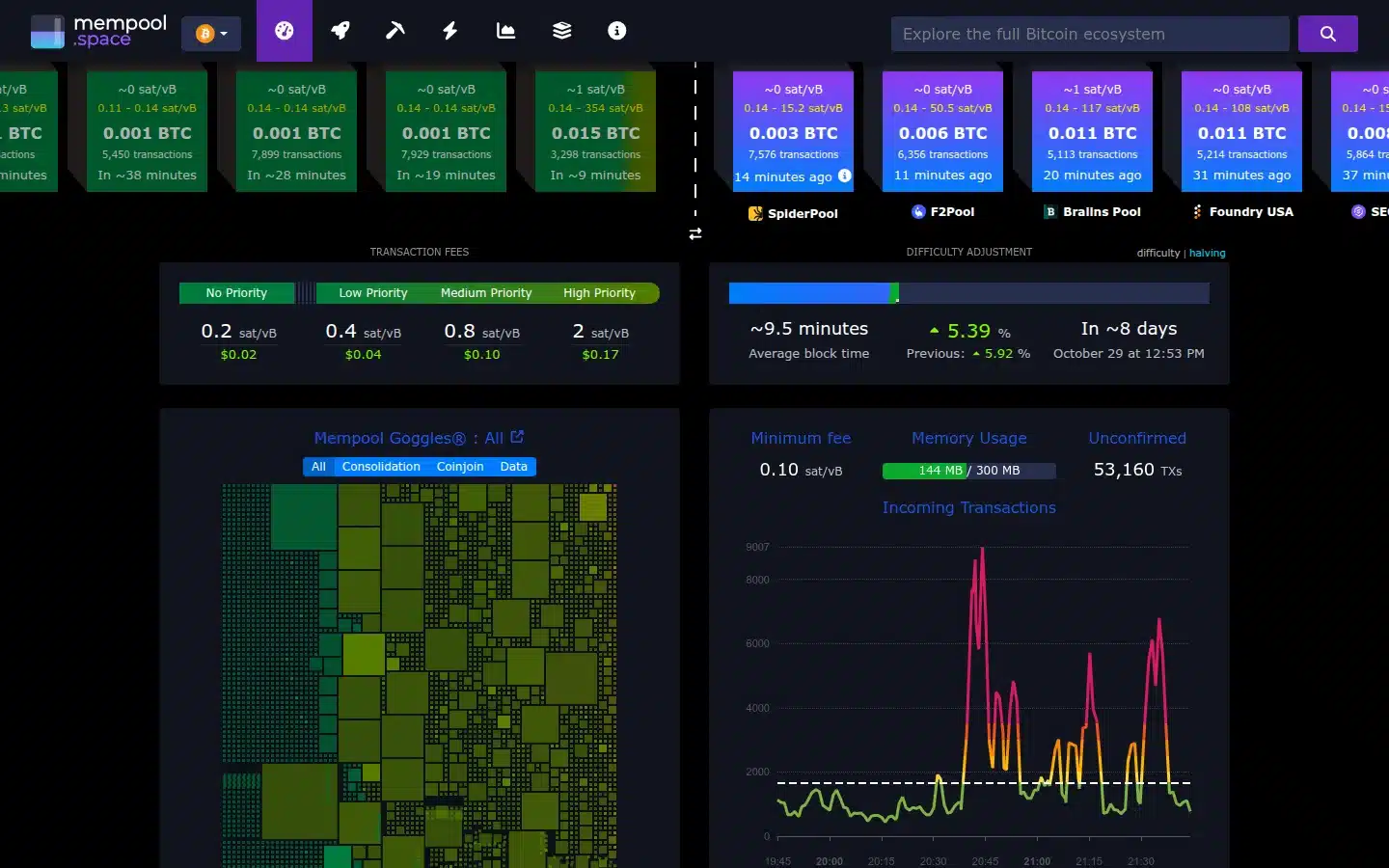




Bitcoin’s mempool told two very different stories in 2025. The year opened with a large backlog of unconfirmed transactions that drained within weeks, settled into months of unusually quiet, low-fee conditions, and then began rebuilding toward the end of the year as network activity returned. For anyone sending Bitcoin, those swings translated directly into cost and waiting time: confirmation can take anywhere from one minute to several hours depending on the network’s congestion.
What the Bitcoin Mempool Is
The mempool is the waiting area for unconfirmed Bitcoin transactions. Every node on the network maintains its own mempool, so the exact queue can vary slightly from node to node, but the basic job is the same everywhere: pending transactions wait until a miner selects them for a block. When transactions arrive faster than blocks can confirm them, the mempool grows and congestion follows. As Blockchain.com’s mempool-size chart notes, a high mempool size indicates more network traffic.
Fees are expressed in satoshis per virtual byte (sats/vB). A transaction of 200 vB paying 50 sats/vB costs about 10,000 satoshis. Miners rank transactions by fee relative to size and prioritize higher-fee transactions, which is why a congested mempool turns into a bidding contest. SegWit expanded theoretical capacity, but realistic blocks still vary between 2–4 MB, leaving limited headroom during demand spikes.
Why Congestion Happens
Block space is finite, so congestion appears when demand for block space outruns supply. Data-heavy uses such as Ordinals and BRC-20 minting make transactions larger, while big market moves and exchange-related transfers add sudden bursts of demand. Both dynamics push users to bid higher in fees to move up the queue.
For scale, the heaviest congestion in recent memory predates 2025: Grayscale Research noted that as of May 8, 2023, the network was experiencing a record high of 465,000+ transactions awaiting confirmation. Nothing in 2025 approached that peak, but the same supply-and-demand mechanics drove every swing of the year.

Protocol Changes That Shaped the Queue in 2025
Bitcoin Core’s own rules also shape the queue. In September 2025, Bitcoin Core v29.1 reduced the default minimum relay fee from 1 sat/vB to 0.1 sat/vB. In November 2025, cluster mempool was merged for inclusion in Bitcoin Core v31.0; it changes how nodes track related transactions but does not change on-chain fees, transaction volume, or block size limits.
Mempool Conditions Through 2025
Mempool data through 2025 showed two very different phases: a rapid clear-out early in the year, a long quiet stretch through the middle, and a rebuilding backlog in the closing months.
On Jan. 8, 2025, Johoe’s Bitcoin Mempool Statistics showed a backlog just over 200,000 transactions. The queue then drained quickly. By Feb. 2, 2025, a Bitcoin.com News report said mempool.space indicated 5,988 transfers in the queue, and The Motley Fool reported the backlog fell from roughly 287,000 in late December 2024 to around 3,000 in early February 2025.
By mid-February the network was effectively uncongested. On Feb. 15, 2025, mempool.space showed the high-priority fee at about 1 sat/vB — about $0.14 per transaction — and Bitcoin.com News reported block 883,885 had only 921 pending transfers. Mempool.space’s block-size report identified block 881,851 as the latest prolonged clearing event at the time, with 3 consecutive unfilled blocks.
The quiet extended into summer. Bitget reported the mempool had been thin since mid-May, with median fee rates down to 1 sat/vB or less and blocks often underfilled. On June 9, 2025, several blocks carried fewer than 2,000 transactions and collected only 0.01 to 0.03 BTC in total fees. CoinDesk reported that in early July the mempool held about 5,000 transactions one day and 15,000 at press time — still far below the 150,000 level seen when BTC first moved above $100,000 in late 2024. Blink.sv attributed the near-empty mempool to low network activity and lower fees.
Later in 2025, activity picked up decisively. Bitcoin Magazine, citing CryptoQuant and FXStreet, reported the mempool expanded to about 128,000 pending transactions, its highest level since late February 2025. Bitcoin Magazine also reported, citing CryptoQuant, that daily Bitcoin transactions surpassed 800,000, more than doubling from the lows recorded earlier in 2025.
How to Monitor the Mempool and Set Fees
A useful monitoring routine tracks three metrics together: the median fee in sats/vB, the total size of pending transactions, and the number of pending transactions. Public tools make this straightforward. Mempool.space shows the real-time status of transactions along with network info, and tools like Mempool.space and Blockstream.info give quick fee estimates and block-level data. Running your own Bitcoin Core node provides a direct view of your node’s mempool and can serve as a fallback when browser-based tools require modern JavaScript.
Reducing Fees During Congestion
When congestion is high, several practical tactics can keep costs under control:
- Consolidate UTXOs during low-fee periods. Quiet stretches like the mid-2025 lull, when median fee rates sat at 1 sat/vB or less, are the kind of window this tactic is built for.
- Use SegWit addresses for everyday transactions.
- Batch payments to the same recipient instead of sending them one by one.
- Move small, frequent payments to the Lightning Network rather than settling each one on-chain.
- Use Replace-By-Fee (RBF) carefully. RBF can adjust a stuck transaction, but it requires a compatible wallet and careful use.
Outlook
The 2025 pattern was episodic rather than constant: a near-empty queue at the start of the year, thin conditions through mid-year, and a rebuilding backlog toward late 2025. Because block space remains limited, fee spikes are likely whenever demand clusters around market events, ETF flows, or data-heavy applications. Watching the mempool and matching transaction timing to observed conditions remains the practical way to avoid surprise fees.