

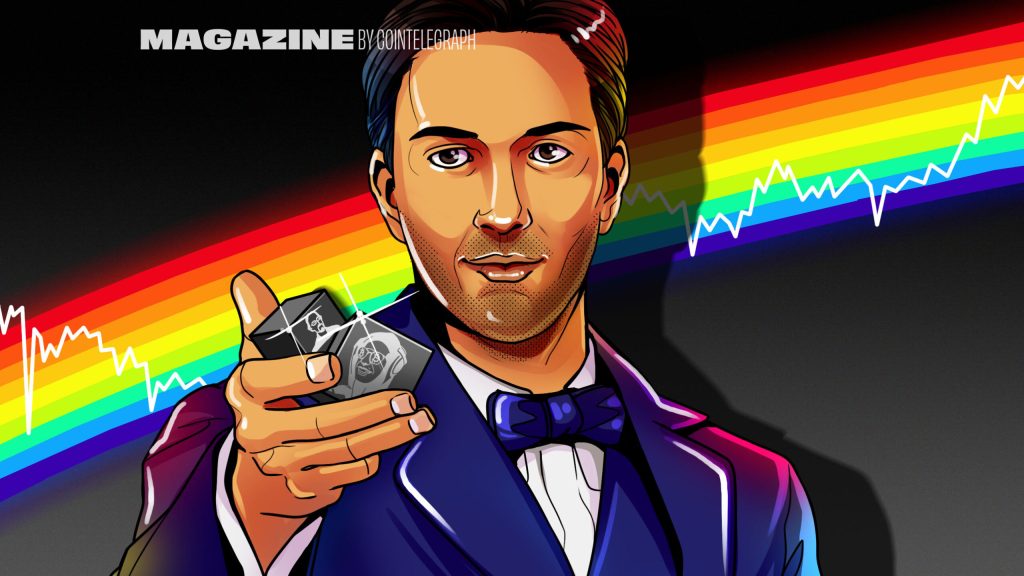

Although he’s had a variety of jobs in the industry, including a stint as Arcane Asset’s chief investment officer, Eric Wall is probably best known for shitposting and arguing with people on Crypto Twitter.
“Just like any other person, I’m scrolling my Twitter feed, and then you see people saying dumb shit that is incorrect, and that is based on a lie. And then I just argue with that person, and then those arguments lead to long-form Medium articles,” he says with just a faint trace of a Swedish accent.
“I’m just trying to correct ‘incorrectness’ in the space.”
He’s been working on a super-secret project ever since he left Arcane early last year, so he doesn’t have an official title apart from “blockchain researcher” and board member for Ethereum scaling solution the StarkNet Foundation.
After arguing with people for years for free, more recently, Wall has been attempting to make money from challenging antagonists to a bet and has also (semi-literally) begun collecting the skulls of his enemies. “That has been paying off in tungsten cubes and actual money,” he says.
“There’s multiple cryptocurrency communities who have me as their favorite hate object basically. They want to put you in your place. And they have all sorts of idiotic ideas.”

Wall recently moved to Portugal from Sweden, attracted by the crypto-friendly regulation and the lifestyle — and for safety reasons, after the next most prominent crypto future in Sweden was physically attacked in an attempt to steal his crypto. He explains the tax system there is so transparent that anyone can look up your net wealth. “If you combine that with the fact you know they’re into crypto, and it’s very easy to pick out targets in Sweden,” he says.
Wall says he paid for the rent on his new flat through the hatred of HEXicans. He’s been at loggerheads with the HEX community since 2019 when founder Richard Heart explained the scheme to him. In February last year, he made a bet with HEXican Dixon Piper that HEX — then trading at $0.18 — wouldn’t reach a new all-time high by February 2023.
While he hasn’t won yet (but almost certainly will, given HEX’s current price), after HEX plunged to $0.04, he was able to hedge the bet and lock in a profit of $16,000 to pay for his apartment in Lisbon.
“I have this place now with just the most amazing view that I’ve ever seen in my life. I see the entire Portuguese coast from that window, from that balcony. I can have these HEXicans telling me how stupid I am while looking at that view.”
Similarly, he bet Blockstream CEO Adam Back that PlanB’s “floor model” was going to be wrong — which it was. “So, Adam had to pay up a tungsten cube with his face engraved into the cube,” he says. He won another bet against Bitcoin Magazine’s CK Snarks that the Ethereum Merge really would happen in 2022.
His plan is to build up a collection of 20 tungsten cubes with the faces of his vanquished foes so that people think twice about arguing. “You’re going to be pretty intimidated,” he says. “Do you want to be the next face in this collection?”
Bitcoin maxi to mini
Wall is a recovering Bitcoin maximalist who was once known as the “altcoin slayer” for his brutal takedowns of altcoins during the era of ICOs. One of the most qualified critics in the space — he literally wrote his Master’s thesis about blockchain — he can zero in on technological issues and communicate those problems effectively to less technical members of the crypto community.
Back when he was pointing out that most ICO altcoins were centralized shitcoins with myriad security issues, he was a hero to Bitcoiners. But ever since he started busting myths about Ethereum and suggesting that Bitcoin was being left behind by smart contracts, scaling and NFTs, they’ve liked him much less.
As you have no doubt gathered, Wall goes to great lengths to prove he is correct and once spent a month downloading an Ethereum node purely to bust the Bitcoiner myth that it took 8 terabytes of data to fully validate transactions.
“It was extremely difficult, but it was possible, and it didn’t take 8 terabytes of space on the hard drive.”
One of the big reasons for the shift from maxi to mini (he’s still a proponent of Bitcoin) is that Wall has been fascinated for years with building decentralized finance on an open and permissionless settlement layer. That was the essential subject of his thesis, and the need for decentralization to bring it about was only reinforced by seeing the limitations of permissioned blockchain platforms while working for Cinnober and Nasdaq. So, he was naturally drawn to the DeFi sector on Ethereum when it began to emerge in 2019.
That same year, it became clear that Ethereum and other blockchains could scale using zk-Rollups or optimistic fraud proofs, whereas Bitcoin had “almost entirely abandoned” the idea of doing anything with DeFi. So, he got behind DeFi on Ethereum.
“That made me fall out of favor with Bitcoin maximalists because I was their golden kid: the one that was supposed to slay the altcoins, not one that was supposed to say actually, there is a use case here though, and this system actually does scale, and it’s not as bad as you think.”

“So, then I had to change Bitcoiners’ understanding of the Ethereum system because they were now the ones that were spreading false facts about how the system works.”
He concedes his former Bitcoiner friends think he’s become a “shitcoiner for financial motives.” But Wall also wants to scale Bitcoin, too, and is involved in a research project with StarkNet and the Human Rights Foundation to investigate how to apply zk-Rollup scaling to Bitcoin, pondering “what the benefits of that would be and how feasible it is.”
“So, I am working on that, on trying to introduce that system and those technological benefits to Bitcoin.”
What’s behind the Wall?
Wall was born in 1991 in the Swedish city of Linköping and spent a gap year after high school traveling through Australia and Norway, working odd jobs from a deckhand on a luxury yacht to a “chugger” (charity mugger).
He studied computer engineering at Lund University, and his time there was notable for his organizational efforts as the “funmaker” of “Sweden Silent Party,” a series of silent disco events inspired by one the best nights of his life in Byron Bay. He also became one of the first Scandinavian engineers to write a Master’s thesis about using blockchain to run a securities exchange in conjunction with local fintech Cinnober.

He was introduced to Bitcoin in his first year of university in 2011 by a classmate who showed him an article about darknet marketplace Silk Road. Buying Bitcoin at the time for $4 was a week-long process that required wiring money to Mt. Gox in Japan, so he gave up. A year later, Bitcoin had doubled to $8, and he thought he’d “missed the boat.” “But I became interested in this asset that increased 100% in one year” and saw an opportunity to “get an edge” in a totally new asset class. He lost everything in Mt. Gox but gained a new career as a blockchain researcher and, later, blockchain lead at Cinnober.
During his time there, and later at Nasdaq, he realized that companies or even countries weren’t going to agree to create the sort of infrastructure required to build a genuinely decentralized, cross-jurisdictional system for the settlement of securities.
“It needs to be something that the Chinese and the Japanese and the U.S. can use as a mutual system,” he says. “But that was a gargantuan task. That’s never going to happen from the inside. I understood that later. It has to be a system that comes from the outside and keeps growing.” The only likely candidates were Bitcoin and Ethereum.
He told his bosses to put a hold on the enterprise blockchain stuff and to instead sell their incredibly fast matching engine tech to the big crypto exchanges. His colleagues thought crypto was a game or a joke — until Bitstamp turned up in a private jet.
“Even big stock exchange teams didn’t spend that kind of money on a meeting with Cinnober,” he says. “Then they actually did take it seriously, and we did deliver a solution to them.”
Read also
Features
Crypto mass adoption will be here when… [fill in the blank]
Features
How Silk Road Made Your Mailman a Dealer
Media crypto commentator
During this time, he also became the Swedish media’s go-to guy for crypto commentary. He was determined to seize the opportunity but hated the stressful, anxiety-inducing process of appearing on live TV, so he’d load up on valium to get through it.
“Then everything was fine. It didn’t matter like getting a big camera in my face. I was completely zoned out,” he says.

“But because I was so into crypto, I was doing crypto 17 hours a day. Even in that state, I could still articulate and explain everything about Bitcoin and what was going on even if I was only half conscious.”
It was a similar story at crypto conferences, where Wall’s ingrained Swedish standoffishness made the hundreds of brief interactions he had as a well-known figure quite stressful.
“For them, they only get, like, five seconds with me on an escalator, and that’s how they’re going to remember me for years. So, I always feel like I want to deliver on that interaction. Which makes me feel a lot of pressure.”
He’s stopped taking meds these days after realizing he was meeting the same people multiple times at conferences and forgetting them.
“I have realized that now, at this point, like, I’m gonna just be natural. I think I feel comfortable. I’ve overcome my Swedishness eventually.”
Nasdaq takeover
Cinnober was eventually taken over by Nasdaq in early 2019 for $190 million, and Wall found himself in a massive bureaucratic organization with little agency and lots of rules.
“After Nasdaq acquired, they told us, well, ‘The great thing about Nasdaq is you’re never gonna have more than six bosses above…’ It’s a very flat organization,” he says with dry humor. “Every tweet that I wrote had to go through the Nasdaq approval department.”
At the time, Wall was fighting with multiple token projects online about their hyped claims. “I thought that I was doing something very important,” he explains. One notable conflict, still running today, was with the Iota founders after he argued in a 2017 Medium post saying the protocol does not provide any censorship resistance and is centralized around the Iota foundation’s coordinator node.
Unfortunately, Iota was also being considered by the Swedish Central Bank to help create a central bank digital currency, so Wall’s online antics were not considered politically helpful.
“People were lying about what their technology could do, and you still had to treat them as respected industry participants, which I wasn’t going to do. So, I didn’t ask for permission from Nasdaq to tweet, and it ended up with us going our separate ways.”
Subscribe
The most engaging reads in blockchain. Delivered once a
week.

Arcane Assets
Wall then decided the best way to participate in the blockchain revolution was to participate in the economy, “So, I changed strategy and became a hedge fund manager,” he says.
It’s quite the leap from engineer to trader, and Wall tried and abandoned a variety of approaches. Initially, he learned technical analysis, using rules-based trading around indicators like Bollinger Bands and moving average convergence/divergence. But after writing an algorithm to backtest the rules, he realized they performed no better than random chance. Similarly, he thinks most charts and models are ludicrous, which is why he constantly jokes about the superiority of the Rainbow Chart (“has emoji”).
Then he moved on to investigating the technological fundamentals of projects to guide investment decisions, only to see his returns totally dwarfed by people who invested based on what the logo looked like. He’s since settled on a new approach to trading: Work out what unsophisticated investors will buy in the future and buy it first.
“The price is driven by just social factors. Basically, there’s no fundamentals,” he explains. “When I go out and I write some articles about a particular technology component in some cryptocurrency that undermines the whole value proposition, that’s a completely different thought process than the investment process. The investment process is just about, well, are people going to buy it?”
But having to explain to his serious hedge fund bosses that he was buying tokens because he thought the masses would buy any old token with a dog on it, was tricky.
“That was one of the things that I didn’t like so much. These are regulated, traditional ‘we run a pretty posh hedge fund that took capital from institutional level investors’ and they don’t want to hear: ‘Well, people like the dog picture.’ But that’s how the market works.”
He recalls investigating whether investing based on the viral growth of crypto hashtags on TikTok could be a path to riches, but the fund wouldn’t give the strategy the go-ahead. Instead, Arcane insisted he invest based on rules and a checklist “to make it an institutional-grade crypto fund that avoided all the bullshit.”
“Problem is if you avoid all the bullshit, you avoid most of the profit.”
So, again, Wall found himself chafing at the requirements of working for a big organization.
“I think I’m like a degen in my blood. I think that the cryptocurrency space moves extremely fast, and you have to be as nimble as the space is. If the market one day says ‘Okay, but screw all the technology — we’re trading pictures of monkeys now,’ you have to make the decision extremely fast that monkeys is what it is all about.”
“So, if I’m going to do something else, now it’s going to be somewhere where the mandate is completely open.”
He handed in his resignation in the first quarter of 2022 to work on a super-secret project that he’s yet to reveal even a year on.
“I’m now in the process of doing something else that hasn’t been announced yet,” is all he’ll reveal.
Read also
Features
How the crypto workforce changed in the pandemic
Features
Crypto Crimes Rated: From the Twitter Hackers to Not Your Keyser, Not Your Coins
