

You might be asking whether you can still mine Ethereum in 2026. The short answer is no, at least not in the traditional sense. Ethereum mining ended permanently in September 2022 after The Merge, when the network moved from proof-of-work to proof-of-stake. That change wasn’t temporary, and it’s still in effect.
Key Takeaways
- Ethereum can no longer be mined with traditional Proof-of-Work methods; mining ended in September 2022 after The Merge.
- Ethereum transitioned from Proof-of-Work to Proof-of-Stake, reducing energy consumption by an estimated 99.95 percent.
- Former Ethereum miners can redirect GPUs to alternative cryptocurrencies like Ethereum Classic, Ravencoin, Ergo, or Flux.
- Staking has replaced mining as the primary way to earn Ethereum, requiring 32 ETH for solo validation or smaller amounts through staking pools.
- GPU mining profitability still depends on electricity costs, hardware efficiency, and market conditions.
What Happened to Ethereum Mining?
Ethereum mining didn’t just slow down or become less profitable—it stopped entirely. On September 15, 2022, Ethereum completed a transition that had been years in the making. The network moved away from its original consensus mechanism, and miners who had been securing the blockchain suddenly found their equipment obsolete for Ethereum purposes.
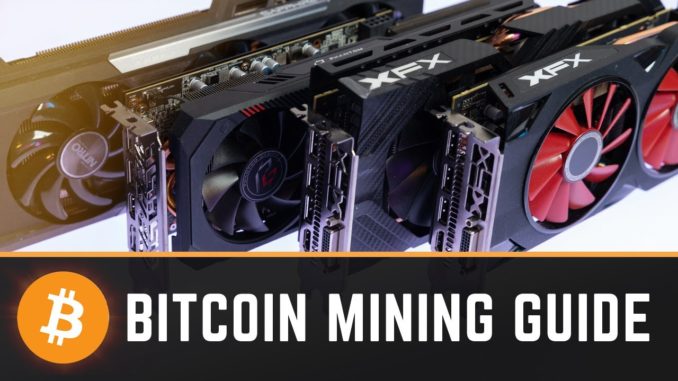
Before this change, Ethereum operated much like Bitcoin does today. Miners used powerful graphics cards to solve complex mathematical problems, competing to add new blocks to the blockchain. The first miner to solve each puzzle earned newly minted ETH plus transaction fees. This system worked, but it came with significant drawbacks that eventually led to its replacement.
The Merge and the End of Proof-of-Work
The Merge marked Ethereum’s shift from Proof-of-Work (PoW) to Proof-of-Stake (PoS). Under the old PoW system, computational power determined who got to validate transactions and create new blocks. Proof-of-Stake changed everything: instead of miners competing with hardware, validators stake ETH as collateral to earn the right to validate transactions.
As ethereum.org puts it, “Proof-of-work is no longer underlying Ethereum’s consensus mechanism, meaning mining has been switched off.” CoinWarz also notes that PoW mining ended at a Terminal Total Difficulty (TTD) of 58750000000000 for Ethereum and that Ethereum has switched to PoS.

The transition happened when Ethereum’s existing chain merged with the Beacon Chain, which had been running PoS since December 2020. For miners, The Merge was the end of an era. Overnight, Ethereum mining rigs that had been generating income became useless for their original purpose.
Why Ethereum Transitioned to Proof-of-Stake
Ethereum’s developers didn’t make this change on a whim. The shift to Proof-of-Stake addressed several fundamental problems with the mining-based approach.
Energy consumption topped the list. At its peak, Ethereum mining consumed roughly as much electricity as entire countries. Proof-of-Stake reduced Ethereum’s energy usage by an estimated 99.95 percent—a complete transformation of the network’s environmental profile.
Scalability was another major factor. Proof-of-Work inherently limits how quickly a blockchain can process transactions. Ethereum’s developers had long-term plans for scaling solutions, but these upgrades required a PoS foundation. Security considerations also played a role: attacking a PoS network requires acquiring a massive amount of ETH and putting it at risk. If validators try to cheat the system, they lose their staked coins.
Centralization concerns factored in as well. Mining had become increasingly dominated by large operations with access to cheap electricity and bulk hardware. Proof-of-Stake lowered the barrier to participation—anyone with 32 ETH could run a validator node, and smaller holders could participate through staking pools. The transition also aligned with Ethereum’s broader vision as a platform for decentralized applications, smart contracts, and eventually Web3 infrastructure.
What to Do With Your Ethereum Mining Equipment
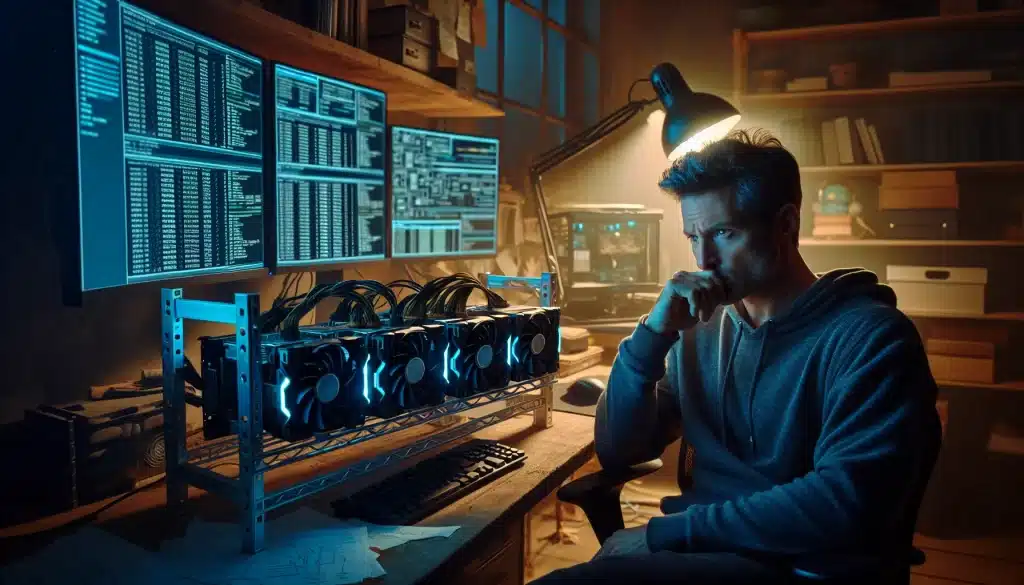
If you’ve got mining rigs sitting idle after The Merge, you’re not alone. Your equipment still has value—you just need to redirect it.
Mine Alternative Cryptocurrencies
Your GPUs can still mine other cryptocurrencies that use Proof-of-Work. When Ethereum mining ended, many miners shifted to alternatives like Ethereum Classic (ETC), Ravencoin (RVN), Ergo (ERG), and Flux (FLUX). These coins welcomed the influx of hash power, though it also meant increased competition and lower individual rewards.
Ethereum Classic deserves special mention because it’s essentially the original Ethereum blockchain that continued using PoW after a controversial split in 2016. The network is still active: 2Miners lists ETC with Algorithm ETCHash and a pool hashrate of 18.88 TH/s, while MiningPoolStats reports a network hashrate of 170.52 TH/s and Algorithm Etchash. Some miners view ETC as the natural successor for GPU mining, though its market cap and liquidity are far smaller than Ethereum’s.
Sell or Repurpose Your Hardware
Selling your mining equipment is straightforward if you’ve decided mining isn’t worth continuing. The market for used mining GPUs exists, though prices dropped significantly after The Merge as thousands of miners tried to liquidate simultaneously. You won’t get what you paid during the GPU shortage of 2021, but you can recover some value.
Repurposing offers another path. Gaming GPUs that were mining can return to their original purpose. Some miners have converted their rigs into rendering farms for video production, AI model training, or password recovery services. These applications use GPU processing power differently but can generate income if you have the right clients or projects.
How to Earn Ethereum Today Without Mining
Mining might be gone, but earning Ethereum hasn’t disappeared. The methods have just changed.
Staking Ethereum for Rewards
Staking replaced mining as Ethereum’s reward mechanism. When you stake ETH, you’re essentially locking it up to help secure the network. In return, you earn rewards—newly issued ETH plus a portion of transaction fees.
Running your own validator node requires 32 ETH. You’ll also need to maintain hardware that stays online and connected, though the requirements are far less demanding than mining equipment. Validators earn annual percentage yields that vary based on network conditions but typically range from 3 to 5 percent.
If you don’t have 32 ETH, staking pools offer an alternative. Services like Lido and Rocket Pool, as well as some centralized exchanges, allow you to stake smaller amounts. You earn rewards proportional to your contribution, minus the pool’s fees. Liquid staking has become popular because it gives you a token representing your staked ETH, which you can use in DeFi protocols while still earning rewards.
Other Ways to Acquire Ethereum
Beyond staking, you can buy ETH on exchanges, provide liquidity on decentralized exchanges, or lend ETH through protocols like Aave and Compound to earn interest. Some people earn ETH through work, getting paid in cryptocurrency for services, freelancing, or contributing to blockchain projects.
Popular Alternatives to Ethereum for GPU Mining
If you’re determined to keep mining with your GPUs, you’ve got options. Ethereum Classic stands as the most direct alternative. Ravencoin gained significant attention among GPU miners because it’s designed for asset transfers and was built with ASIC resistance in mind. Ergo focuses on being a smart contract platform using PoW and is designed to be ASIC-resistant. Flux offers another option with its focus on decentralized cloud infrastructure and node-based rewards.
None of these coins individually match what Ethereum mining was at its peak. The community is more fragmented, liquidity is lower, and the future is less certain. But for miners who want to keep their rigs running, these alternatives provide options.
Is Cryptocurrency Mining Still Profitable in 2026?
Profitability in crypto mining has always been a moving target, and 2026 is no exception. Electricity costs make or break mining operations. If you’re paying residential rates in areas with expensive power, mining most coins will lose you money. To compete effectively, you need electricity under ten cents per kilowatt-hour—at minimum, preferably much less.
Hardware efficiency matters more now than it did during Ethereum’s PoW era. Older GPUs that were marginally profitable mining ETH might not break even on alternative coins. Newer, more efficient cards have better chances, but they also cost more upfront. Market conditions can flip profitability overnight. Many miners in 2026 are essentially speculating that the coins they mine will appreciate in value.
For most people considering mining in 2026, the honest assessment is that it’s become more of a hobby or a bet on future price appreciation than a reliable income source. Large operations with scale advantages, cheap power, and professional management can still profit. Individual miners with a few GPUs in their garage are fighting uphill.
Conclusion
Ethereum mining is definitively over. The Merge wasn’t a temporary change or something that might be reversed—it’s the new reality of how Ethereum operates. If you’re holding mining equipment hoping for a return to PoW, you’re waiting for something that won’t happen.
That doesn’t mean your options have disappeared entirely. Alternative coins still use Proof-of-Work and can be mined with GPUs. Whether that’s worthwhile depends on your electricity costs and your belief in those projects’ futures. Staking has replaced mining as the way to earn ETH through network participation, and for many people, it’s actually more accessible than mining ever was. If you’re specifically asking whether you can still mine Ethereum the way you could in 2021, the answer is clear: no, you can’t.
Frequently Asked Questions
Can you still mine Ethereum in 2026?
No. Ethereum mining ended permanently in September 2022 after The Merge. Ethereum transitioned from Proof-of-Work to Proof-of-Stake, eliminating mining entirely. Validators now secure the network by staking ETH instead of using mining equipment.
What happened to Ethereum after The Merge?
The Merge shifted Ethereum from Proof-of-Work to Proof-of-Stake, ending GPU mining. This reduced energy consumption by an estimated 99.95 percent and changed how the network validates transactions.
What can I mine with my GPU after Ethereum switched to Proof-of-Stake?
You can mine alternative cryptocurrencies like Ethereum Classic, Ravencoin, Ergo, and Flux. These coins still use Proof-of-Work, though profitability depends on electricity costs and current market conditions.
How much ETH do you need to start staking Ethereum?
Running your own validator node requires 32 ETH. However, if you have less, you can participate through staking pools like Lido or Rocket Pool, which allow you to stake smaller amounts and earn proportional rewards.
Why did Ethereum switch from mining to staking?
Ethereum switched to Proof-of-Stake to reduce massive energy consumption, improve scalability for future upgrades, enhance security through economic deterrents, and align with its vision as a platform for decentralized applications and Web3 infrastructure.